

The Parenting No One Talks About: Helping a Neurodivergent Teen Through a Spiral
A gentle, honest pep talk for caregivers carrying the mental load of ADHD, impulse, and starting again — again.
Okay. Come sit by me for a second.
Because if you’re parenting a neurodivergent kid — especially an adolescent — there are days where you think:
Are we actually making progress?
Or are we just looping the same day over and over?
And I want you to know right away — if you’re here, asking these questions, feeling this heavy?
You’re not doing it wrong.
You’re just tired.
There’s a kind of exhaustion that comes with parenting a kid whose brain moves faster than their ability to slow themselves down.
It’s not loud exhaustion.
It’s the quiet kind.
The kind that comes from constant vigilance.
From always watching.
From always anticipating.
From needing to be ten steps ahead so they don’t make a decision that blows up the next hour… or the next week.
And the hardest part?
Sometimes it feels like they genuinely don’t understand how their behavior affects anyone else.
Not because they don’t care — but because their brain literally isn’t connecting those dots yet.
And that’s a really lonely place to sit as a parent.
Because you see the ripple effects.
They don’t.
And you’re the one holding all of it.
Let me say something gently, as your friend — not as an expert.
When our kids are in what I call a shit spiral, staring at the spiral doesn’t help.
We can talk about it.
We can analyze it.
We can name it over and over again.
But none of that actually helps them climb out.
We don’t need to admire the problem.
We need something to grab onto.
Because here’s what the research — and lived experience — both tell us:
A lot of these behaviors aren’t about attitude or disrespect.
They’re about impulse.
About a brain that goes,
“I need relief right now,”
even when the choice makes absolutely no sense to the adult watching it happen.
So when you’re standing there thinking,
Why would you do that? Why would you download a video game when you’re supposed to be doing homework? Why would you take a soda without permission?
The honest answer is often:
Because in that moment, their brain couldn’t pause long enough to choose differently.
That doesn’t make it less frustrating.
But it does change how we help them through it.
Here’s what actually helps — and I wish someone had told me this sooner.
First: when they’re in it, don’t try to fix everything.
You can’t teach in the middle of a spiral.
You can’t reason someone out of dysregulation.
The goal in those moments isn’t a lesson.
It’s a pause.
Sometimes that means stepping away.
Changing rooms.
Taking a walk.
Letting the moment settle before addressing anything.
That’s not giving up.
That’s protecting both of you.
Second: shrink the timeline.
“Make better choices” is way too big.
Even “finish your homework” can be too big.
Instead, we think:
What’s the next ten minutes?
Just ten.
Ten minutes creates a win.
Wins create momentum.
Momentum is gold for an ADHD brain.
You’re not lowering expectations.
You’re meeting their nervous system where it actually is.
Third — and this one saves your sanity — stop holding everything in your head.
Neurodivergent kids struggle with working memory.
So the constant verbal reminders?
They don’t land the way we think they should.
Written checklists.
Visual reminders.
Things they can see without you having to say it again.
This isn’t about independence yet.
This is about external structure until internal structure develops.
And that’s developmentally appropriate — even if it doesn’t feel like it.
Fourth: separate your kid from the behavior.
This one is huge.
Instead of “you’re making bad choices,” “You’re so untrustworthy!”
try something like:
“Your brain is stuck right now. We’re going to help it reset.”
That one sentence can change everything.
Because kids don’t just hear what we say —
they absorb who they think they are.
And most neurodivergent kids already feel behind.
They don’t need to feel broken on top of it.
And here’s the part I really want you to hear.
Progress doesn’t look like perfect days.
It looks like:
shorter spirals
quicker recovery
more honesty afterward
a little more awareness over time
If you’re waiting for the moment where it all just clicks and stops being hard — you’ll miss the quiet growth happening underneath.
Sometimes progress is simply that the spiral ends sooner than it used to.
That counts.
Even if no one claps for it.
Now let me talk to you — not as a parent — but as a human.
You don’t just parent your child.
You parent the emotional debris of every hard moment.
You’re the one lying awake thinking,
What if this never gets easier?
What if I mess this up?
Why does this feel so heavy all the time?
That mental load is real.
And it’s okay to admit that starting fresh every day — or every hour — is exhausting.
That doesn’t make you ungrateful.
It doesn’t make you weak.
It doesn’t mean you’re failing.
It means you’re carrying a lot.
And you’re still showing up.
Over and over again.
Not perfectly.
But faithfully.
And that matters more than any homework assignment, any screen mistake, any spiral ever will.
You’re not raising a problem.
You’re raising a person — with a different brain — in a world that doesn’t slow down for them.
And you’re doing it with love.
That counts.
Always.
Yesterday I wrote about parenting a child you haven’t figured out yet. Feel free to check that out if you’re struggling. This shit is hard. It makes you second guess everything. It makes the world really lonely because you feel like the only person who generally doesn’t like their child at times. You’re not alone. It’s hard. It’s ok to say it’s hard.
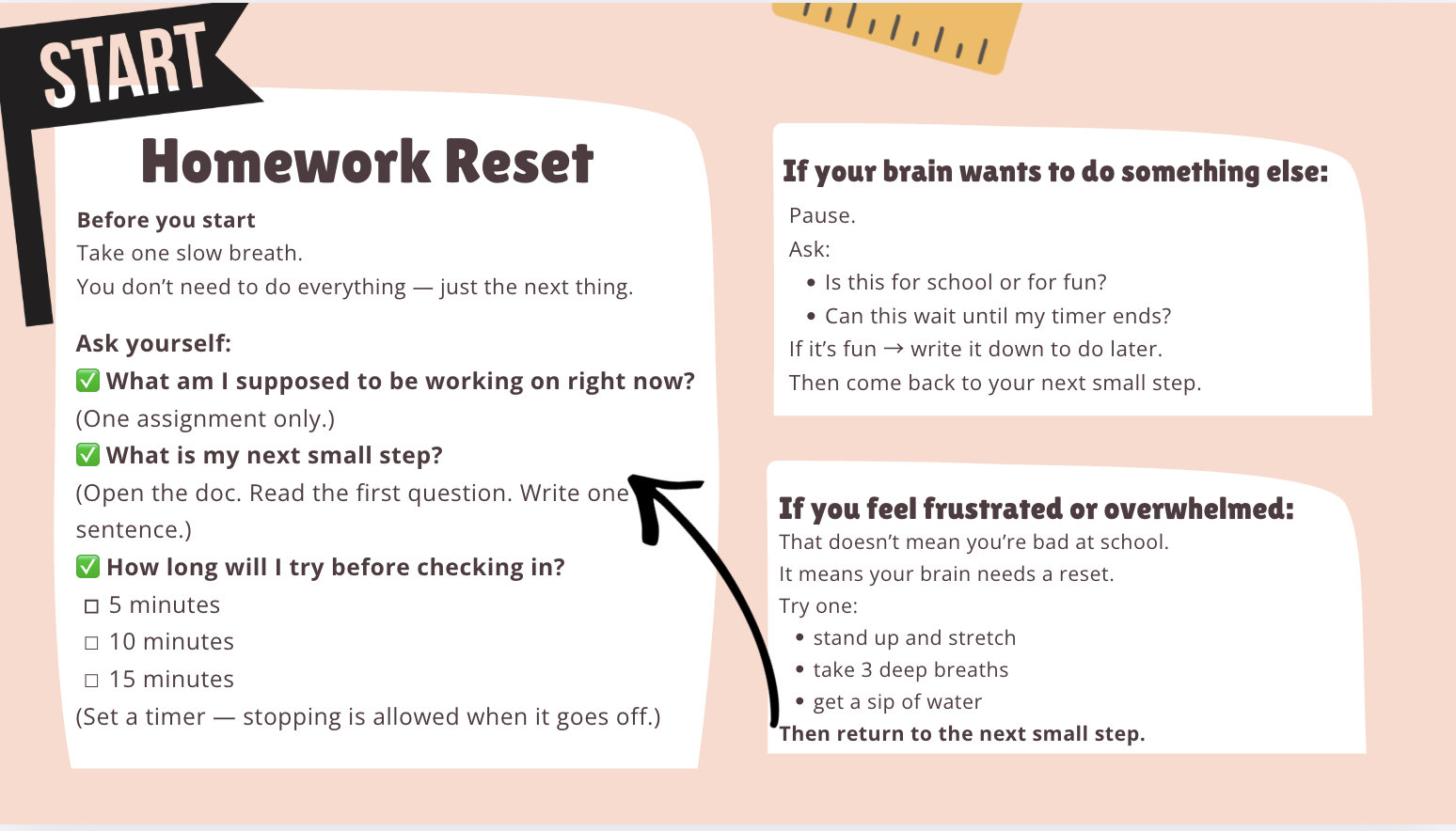
Instead of:
“Why are you doing that again?”
Try:
“Check your card — what’s your next small step?”
This keeps you from becoming the enforcer
and lets the tool do the work.
